Dentures are a solution for restoring a set of missing teeth. They replace the natural teeth by performing the normal function of the oral cavity, providing support to the jaw and the face.
Modern dentistry offers patients advanced dentures with a maximally realistic aesthetic appearance.
Do you really need dentures?
If you are missing teeth or have problems with your gums, it is advisable to visit a prosthodontics specialist. They will carry out a thorough examination of the teeth, gums and surrounding tissues to determine whether dentures are the most suitable solution for you. Seek a consultation in the following cases:
missing teeth
frequent pain or toothache
swollen or red gums
loose teeth
difficulty chewing, biting or speaking
An early visit to the dentist can help preserve the remaining teeth and provide more comfortable and effective treatment.
What type of dentures should you choose?
When you need dentures, the first thing to decide with your dentist is the type of prosthesis you want or need. Dentures can be complete (full) – replacing all the teeth in one jaw – or partial – replacing only the missing teeth and clipping onto the remaining healthy ones.
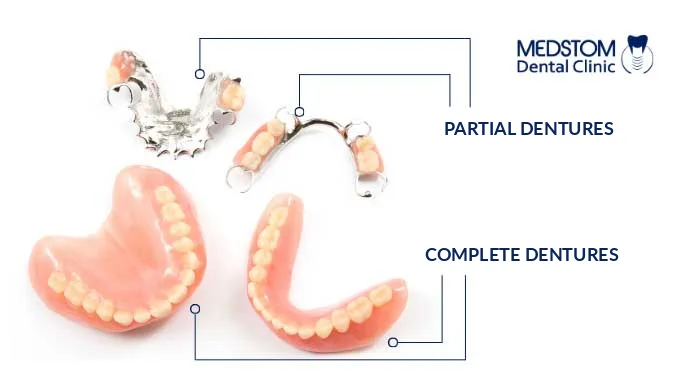
1. Complete (full) dentures
They occupy the entire upper or lower jaw and are designed to replace all of the patient's teeth at once.
A full denture rests on the gums and uses the palate (for an upper jaw) or the jaw ridge (for a lower jaw) as support.
Materials complete dentures are usually made from:
ACRYLIC. Made from acrylic resins with colorants that imitate the natural color of the gums and teeth.
Advantages: cheaper than porcelain dentures, lighter and easier to adjust.
Disadvantages: they wear out faster than porcelain dentures, so their lifespan is shorter. Replacement is usually carried out between 5 and 8 years.PORCELAIN. Porcelain (ceramic) dentures are dental prostheses made from a special dental ceramic.
Advantages: more durable and more aesthetic than acrylic ones.
Disadvantages: more expensive than acrylic ones.FLEXIBLE DENTURE MATERIALS. Made from materials such as polycarbonates, polypropylene and silicones. Unlike acrylic and porcelain dentures, instead of metal clasps they have transparent or pink "little clasps" made of the same material.
Advantages: they adapt to the shape of the gums, which provides more comfort. They are thinner and lighter than ordinary acrylic dentures, less noticeable, and suitable for people allergic to metal.
Disadvantages: dentures made of flexible materials are more prone to accumulating bacteria in or around the prosthesis.COBALT-CHROMIUM (Co-Cr) ALLOYS IN DENTURES. These alloys are used mainly to make the metal framework of partial dentures. Thanks to their properties they give the prosthesis strength and stability.
Advantages: exceptional durability, corrosion resistance, thinner and lighter constructions than fully acrylic dentures.
Disadvantages: higher price, possible allergic reaction in sensitive patients, lower aesthetics if the metal framework remains visible.
2. Partial dentures
They are used when one or several teeth are missing.
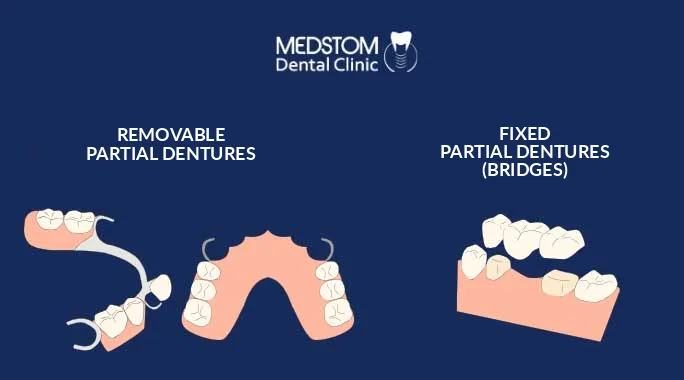
REMOVABLE PARTIAL DENTURES: They consist of artificial teeth attached to a gum-colored base. They often have a metal framework or clasps that grip the natural teeth and provide stability.
Care: removable partial dentures must be taken out and cleaned regularly – best in the evening, leaving them in water or in a special cleaning solution. This protects the material from drying out and extends the life of the prosthesis.
Advantages:
- They restore missing teeth without the need to grind down the neighboring ones (as with bridges);
- More affordable than implants;
- They prevent the remaining teeth from shifting.
Disadvantages:
- They may cause mild discomfort or a feeling of bulk in the mouth at first;
- Metal clasps are sometimes visible and affect the aesthetics;
- They require regular maintenance and good hygiene;
- Their lifespan is much shorter than that of fixed prostheses (bridges, implants);
- Eating may be difficult, especially with hard or sticky foods;
- Unlike dentures fixed on implants, removable dentures do not stop bone resorption in the jaw.FIXED PARTIAL DENTURES (BRIDGES): Used to restore one or several missing teeth by anchoring to the neighboring natural teeth or to implants. They are not removable and provide a stable, permanent replacement for the missing teeth.
3. Implant-supported dentures
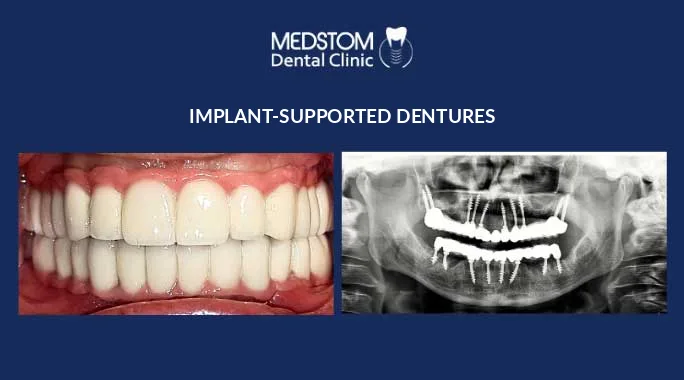
These dentures offer a more secure and comfortable alternative to traditional removable prostheses. They are attached to implants that are surgically placed in the jaw bone. Because of this they provide excellent stability and better chewing function, and they do not require adhesives.
Advantages:
There is no risk of shifting or falling out, which removes discomfort
They support the jaw bone and prevent its loss
They provide a natural appearance, improve the smile and increase self-confidence
Disadvantages:
Considerably higher price than removable dentures
Surgery is required to place the implants
They require several dental visits for professional cleaning and maintenance
How are dentures made today?
Dentures, like other restorative treatments in dentistry, benefit considerably from technological progress. Digital processes for designing and manufacturing prostheses represent an important step forward in the field of prosthetic dentistry.
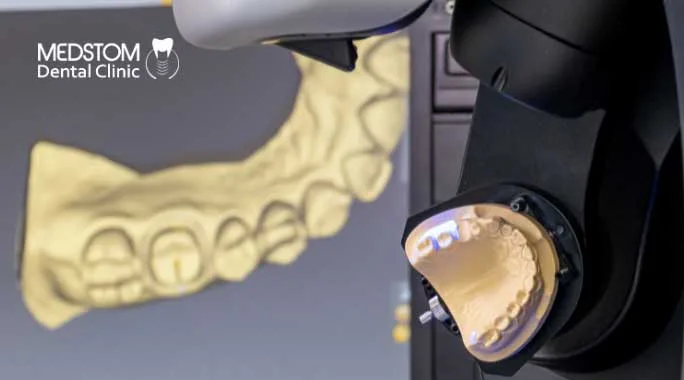
With scanning technologies such as CAD/CAM, dentures can be made faster and more accurately, with less discomfort for the patient. Traditional methods such as impressions are replaced by 3D images that reproduce the exact characteristics of the patient's mouth and teeth.
What does the denture process involve?
Examination and diagnosis: assessment of the condition of the oral cavity and the teeth. Planning the appropriate type of prosthesis and individual treatment;
Preparation of the teeth: treatment of the remaining natural teeth (if necessary). Removal of tartar and residues. Preparing the oral cavity for the prosthesis;
Impression and modeling: 3D based on computer modeling, or a plaster cast, taking into account the bite and the general condition of the jaw and the individual features of the mouth;
Making the prosthesis: the denture is fabricated in a dental laboratory from the material chosen in advance;
Try-in and corrections: testing the fit of the prosthesis for correct passivity, bite and comfort, making additional corrections if necessary;
Fixing: final attachment of the prosthesis. Short instruction on correct use and maintenance if the prosthesis is removable;
Adaptation: monitoring for discomfort, pain or inflammation. If needed, further corrections are made for optimal function.
Care and maintenance of dentures
Proper care is essential both for keeping the dentures in good condition and for the health of the oral cavity. The main measures include:
Daily cleaning: remove the dentures and clean them with a soft brush and a cleaning agent designed for prostheses;
Soaking: removable dentures should be left in water or in a cleaning solution overnight to prevent them from drying out and losing their shape;
Regular dental check-ups: visit your dentist to make sure the prosthesis fits properly and to have the health of the gums and the oral cavity checked.
Additional advice:
Avoid abrasive toothpastes or hard brushes, which can scratch the material of the prosthesis
Keep dentures away from drops, because an impact can damage them
Follow the dentist's instructions regarding wearing time and care of the prosthesis
Wearing dentures can lead to reduced sensitivity, limited chewing ability, a risk of infections and speech problems. It is important for the patient to care for the dentures properly and to consult their dentist in order to prevent possible problems and to ensure the best possible oral health.