

The teeth are an extremely important part of the human body, performing many vital functions.
A tooth has a complex structure made up of several layers. Each tooth performs a specific function. Here is a short overview of tooth anatomy:
Main components of a tooth
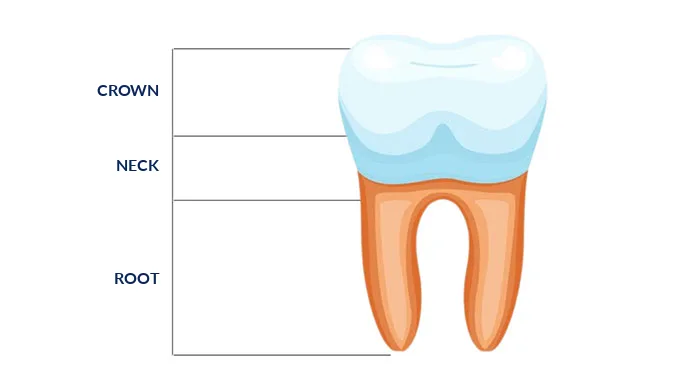
Each tooth consists of three parts:
The crown. It has a different shape and size in the different groups of teeth. It is with the crown of the tooth that food is bitten off, crushed and chewed;
The root. The part of the tooth that lies under the gums and is anchored in the jaw bone. The roots of the teeth may be one, two or three;
The neck. It separates the crown from the root. It is narrowed and closely surrounded by the mucosal gum margin.
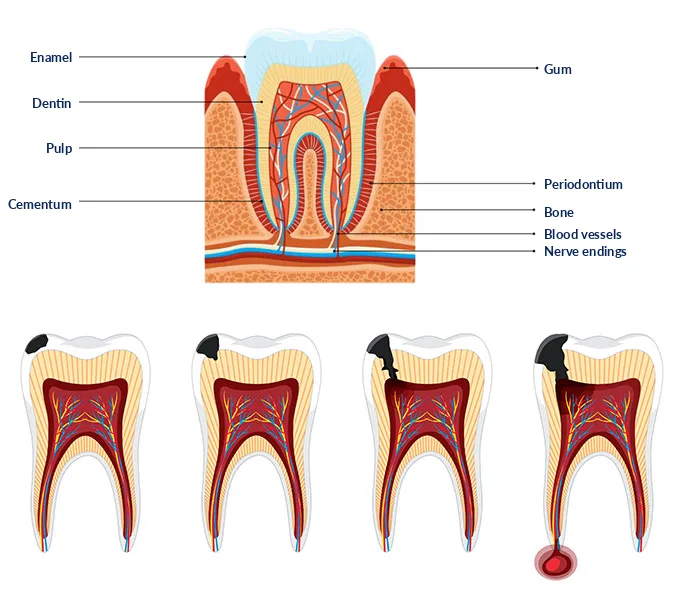
Structure of the teeth:
Enamel is the hardest tissue in the human body. The enamel covers the crowns of the teeth. It protects against mechanical damage and against acid attacks;
Dentine is the main tissue that builds up the tooth. It is softer than enamel and has tiny tubules that lead to the dental pulp. Dentine is responsible for the sensitivity of the tooth to mechanical, physical and chemical stimuli;
The pulp is the soft tissue located in the centre of the tooth, containing nerves, blood vessels and connective tissue. When injured, the pulp bleeds heavily and is very painful, especially in the area of the pulp horns;
Cementum is thinner at the neck and thicker at the root tip. The fibres of the periodontium become embedded in the cementum and connect the roots of the teeth to the alveolar bone;
The periodontium is a bundle of collagen fibres, blood and lymph vessels, nerve endings and cells.
Types of teeth
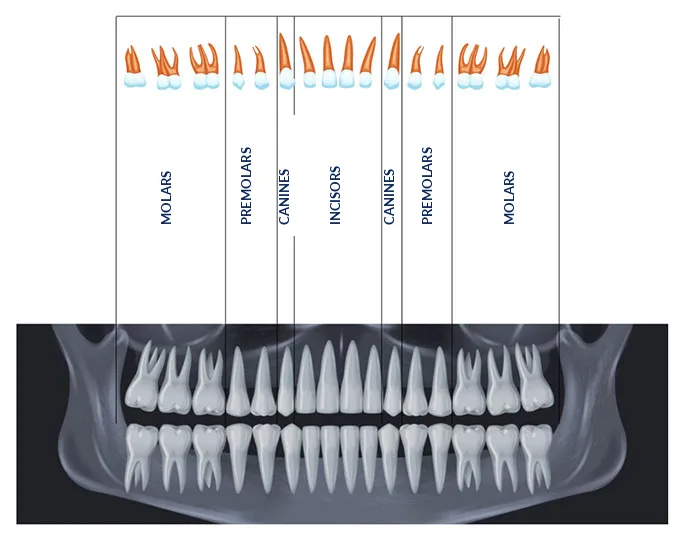
In the human dentition there are 4 groups of teeth:
Incisors. They are positioned at the front of the mouth. Incisors are sharp and thin, designed for cutting food. There are 8 incisors - four in the upper jaw and four in the lower jaw;
Canines. They are found next to the incisors and are pointed. Canines are designed for tearing food. There are 4 in total - two upper and two lower;
Premolars (small molars). They are positioned between the canines and the molars. They have flat surfaces with two or more cusps. Their shape determines their intermediate function: crushing and grinding food. There are eight premolars in total - four upper and four lower;
Molars (large molars). They are located at the back of the mouth. They have large, flat surfaces with many cusps. Molars are designed for grinding and crushing food. The group of large molars in adults consists of twelve teeth.
Development of the teeth
The teeth pass through several stages of development, from embryonic development to the appearance of the permanent teeth. The process of tooth development includes the following phases:
Embryonic phase. It begins around the sixth week of pregnancy. During this phase the tooth buds form in the jaws. The dental cells begin to divide and differentiate, forming the foundations of the primary teeth;
Primary (milk) teeth. The first baby teeth usually appear between the sixth and the twelfth month. Milk teeth are temporary and perform an important function for the child's proper chewing and speech. The formation of the primary dentition is complete by the age of 3;
Permanent teeth. Between the ages of six and twelve the process of replacing the milk teeth with permanent ones begins. The baby teeth fall out and are replaced by permanent teeth, which have to last a lifetime. The wisdom teeth often erupt last, usually between the seventeenth and the twenty-third year.
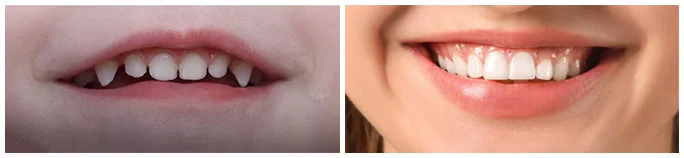
Whatever stage the teeth are going through, proper care is essential for their health and their functionality.
All components of the teeth work in synchrony in order to guarantee: the masticatory function, speech, and the maintenance of a proper facial structure.
Understanding the anatomy of your teeth is essential for maintaining good oral health.


